Medical Imaging Just Hurt Your Back…
A big thank you to Roan Nix, our physiotherapy student, for contributing this to our website!
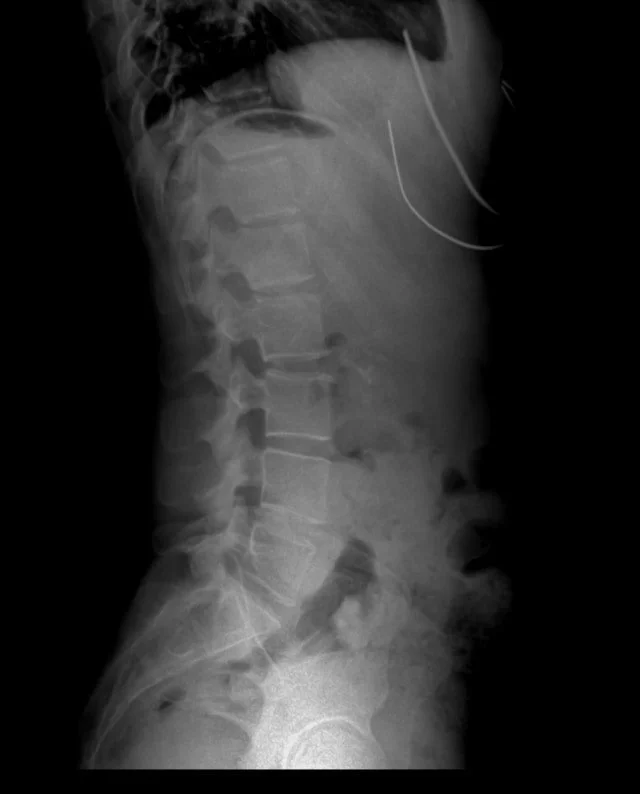
My mom, a 74-year-old who tries to hit her ten thousand steps every day, gardens for hours while in crouched or awkward positions, chases kids around all day, and does dragon boating two times a week, had a serious fall in December that caused her to go in for medical imaging. She ended up being fine and had some bruising, but all things considered it could have been much worse. Now in the Health Care world there is something called a “V.O.M.I.T” – Victim Of Modern Imaging Technology (see Figure 1 below). A V.O.M.I.T is someone who has had imaging (X rays, MRIs, CTs) and then is made aware of all incidental findings associated with that image. These findings often do not explain the symptoms. However, being made aware of these findings may cause significant anxiety and may in turn worsen their symptoms. This can lead to “over-diagnosis” and sometimes “overtreatment,” adding to further distress. In other instances, it simply leaves the person with unease or a general sense of fragility (as illustrated in mom’s experiences below).
After the imaging came back and after medical staff had cleared her and deemed her safe to move, my mom was still hesitant to get back to her normal routines due to the words that she saw on her X-ray report. Compression, degeneration, small disc bulge, and severe narrowing were words that were used in her report. Now remember that my mom is 74 years-old and has never had imaging done on her spine, so we cannot know if these are fall related or natural changes with age that have now been spotlighted due to a fall. We call this pain and discomfort she was feeling, Non-Specific-Low Back Pain. Non-specific because although she had a fall, there were no specific harmful changes to her spine that were identified, just the experience of low back pain.
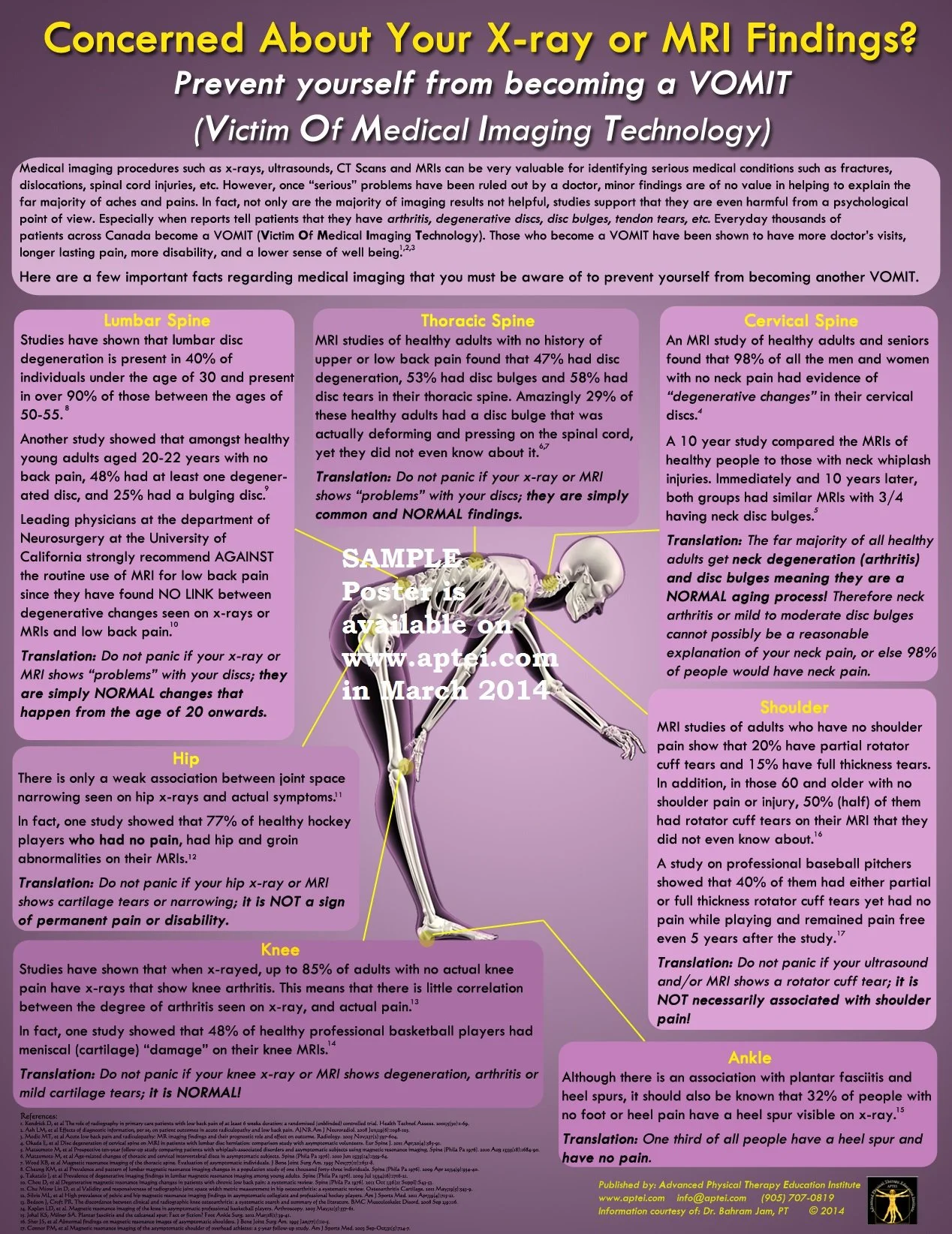
Figure 1: V.O.M.I.T handout describing medical imaging and the limitations it holds.
Movement Is Medicine
What helped my mom most was not another scan, another test, or complete rest, it was gradually returning to movement. Walking, gardening, socializing, and rebuilding confidence in her body became the turning point. IT IS NOT EASY! And it takes time to rewire your nervous system after something traumatic like a fall or even gradual onset of low back pain. The narrative we hear all the time is “be careful of your back!” but the truth is that when we try to protect our back by not moving it, we cause more harm than good.
This is something we see often in physiotherapy clinics. People become trapped in a cycle of fear, avoidance, deconditioning, and worsening pain. The less we move, the more stiff, weak, and sensitive the body can become. Over time, even normal movements can begin to feel threatening and can drive our body into viscious cycle than can be very difficult to unwind.
Guided movement, education, and reassurance can be incredibly powerful tools in recovery. Physiotherapy is not only about exercises or stretches it is also about helping people feel confident in their bodies again.
“It occurs to me that the peculiarity of most things we think of as fragile is how tough they truly are.”
The Takeaway
If you’ve recently had imaging done and your report sounds scary, know that you are not alone. Imaging findings do not always predict pain, disability, or your future ability to move well. Your body is adaptable, resilient, and often much stronger than you think. Also, if you are someone who knows someone or is someone that has Low Back Pain refer them or yourself to a physiotherapist! Whether your goal is returning to gardening, hiking, sports, or simply feeling confident moving through daily life again, a physiotherapist well-trained in pain science can help get you there.
Four Exercises to Start Your Rehab Journey
This is not medical advice, just some exercises that you can do at home to begin to move your body and regain functional strength and mobility. If you don’t feel confident doing these movements, reaching out to a physiotherapist might be the important next step. On the flip side, these are largely safe movements that we should be able to do and will typically improve low back symptoms.
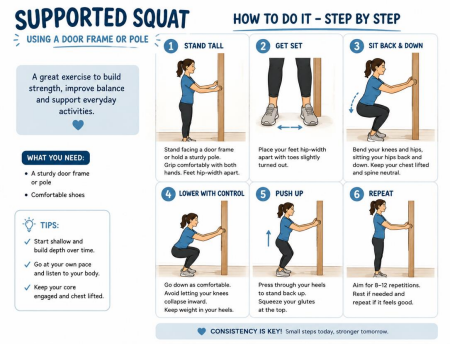
#1 Supported (Pole or doorframe) Squat: The squat is an awesome functional movement! Supported squats help reduce low back pain by strengthening the core, glutes, and legs while improving mobility, balance, and confidence in everyday movements with less strain on the spine.
#2 Modified Cobra is beneficial for low back pain because it gently promotes spinal extension, helping to reduce stiffness and improve tolerance to upright posture and movement.
#3 Bird Dog helps low back pain by strengthening deep spinal and hip stabilizers while training the body to maintain a neutral spine during limb movement, improving overall control and stability while strengthening the core.
#4 Dead Bug is effective for low back pain because it targets deep core muscles and teaches lumbar (lower back) and pelvic control while minimizing stress on the spine during limb movement.
A good starting point would be repeat these four exercises 8-12 times each, one after the other in a single session 2-3 times daily (i.e. morning, afternoon, evening). Take breaks as needed.
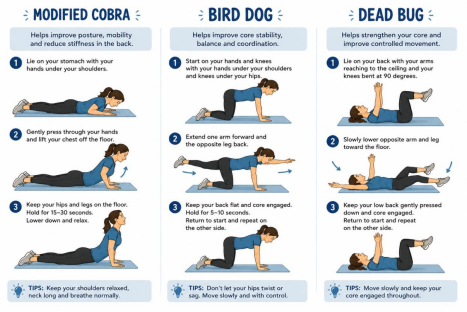
Thanks for reading! Remember imaging tells a part of the story but definitely does not give you the whole picture. Don’t let yourself become a VOMIT!
References
1. O’Keeffe, M., Michaleff, Z. A., Harris, I. A., Buchbinder, R., Ferreira, G. E., Zadro, J. R., Traeger, A. C., Thomas, R., Belton, J., Darlow, B., & Maher, C. G. (2022). Public and patient perceptions of diagnostic labels for non-specific low back pain: A content analysis. European Spine Journal, 31(12), 3627–3639.
https://doi.org/10.1007/s00586-022-07365-x
2. World Health Organization. (2023, June 19). Low back pain.
https://www.who.int/news-room/fact-sheets/detail/low-back-pain
3. Physiopedia. (2022). Low back pain.
https://physiopedia.com/app/uploads/2022/08/cp-vs-ns-lowbackpain-en.pdf 4. MedDoppler. (2018). Medical imaging facts: English [JPEG image]. https://med doppler.com/en-us/accel/medical-imaging-facts-English.jpeg
5. OpenAI (2026), AI generated exercise images
Thanks again to Roan for sharing this with us! I hope it was informative and can help you on your journey!